Securing Water for a Sustainable Future: How ECG Is Shaping the Future of Desalination
As water demand continues to grow and freshwater resources face increasing pressure, desalination is becoming an increasingly important part of water security. But producing water is only the beginning. The greater challenge is designing systems that can operate reliably, adapt to changing demand, and respond responsibly to environmental conditions.
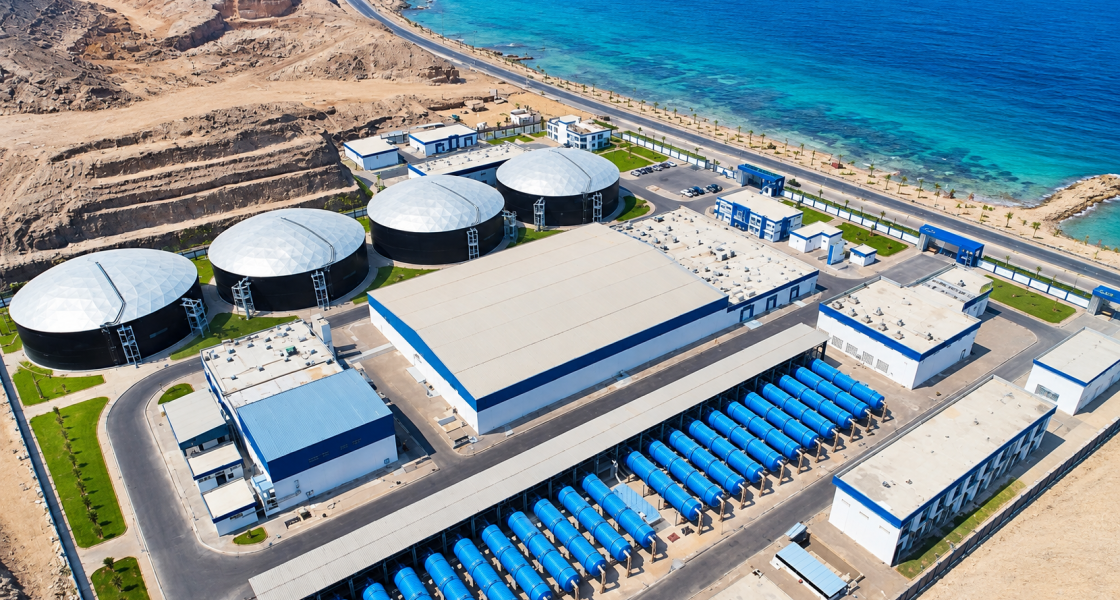
With extensive experience delivering major desalination projects in Egypt, ECG approaches desalination as more than a treatment process. It is an integrated water infrastructure system where reliability, scalability, energy efficiency, and environmental responsibility must be considered together.
More than 300 million people worldwide already rely on desalinated water, but producing water is only the beginning. The real challenge is designing a plant that can continue delivering reliably as conditions, demand, and environmental requirements change.
Designing Reliability from the Start
A reliable desalination plant begins with understanding the water it treats. Seawater conditions can vary with sediments, algae, and biological activity, making the intake and pretreatment systems critical to protecting the downstream reverse osmosis process.
ECG approaches these elements as interconnected systems, integrating intake hydraulics, pretreatment, membrane performance, pumping, storage, instrumentation, and control to support stable operation throughout the plant’s lifecycle.
Building for Tomorrow’s Demand
Water infrastructure cannot be designed only around today’s requirements. The UN projects that 40% of the world’s population could face severe water stress by 2050, making future readiness an essential part of today’s planning.
ECG therefore considers flexibility and expansion from the early design stages. At Al Arish, for example, the desalination plant was designed for an initial capacity of 100,000 m³/day, with expansion to 300,000 m³/day. Such scalability requires more than reserving space. Process systems, pumping, energy, storage, and transmission interfaces must be planned to accommodate future growth.
Sustainability as Part of the Engineering
Sustainability is also embedded in the design process, particularly in two areas: energy and water management.
As desalination is energy-intensive, process selection, hydraulic efficiency, equipment performance, and energy recovery can significantly influence long-term operating requirements.
At the same time, the concentrated brine generated by the process requires careful, site-specific management. Understanding its potential environmental impact early helps shape discharge arrangements, environmental assessment, permitting, and the overall design.
Turning Engineering Decisions into Reliable Infrastructure
ECG’s experience demonstrates how these principles translate into practice. From the 150,000 m³/day Gabal Al Galalah SWRO facility to the expandable East Port Said plant and the New Mansoura RO project, each assignment has required different solutions to different challenges.
Yet the principle remains consistent: reliable water infrastructure is created when every part of the system is designed with the others in mind.
These projects reflect ECG’s commitment to advancing water security through engineering solutions that balance reliability, scalability, and sustainability. By integrating technical expertise with a long-term perspective, we help create resilient water infrastructure that supports communities and a more sustainable future.